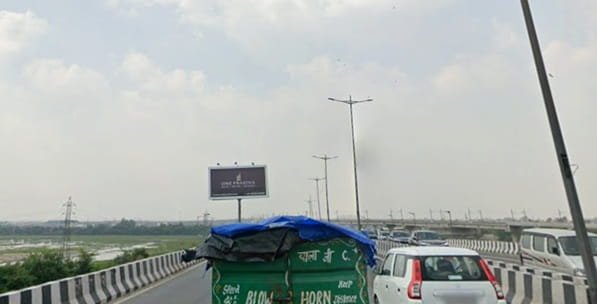
Nallagandla has changed from a relatively quiet western Hyderabad suburb into a dense residential belt closely tied to the Financial District, Gachibowli, Tellapur and the Outer Ring Road. That growth has made its road network far more important than the locality’s internal streets suggest. Nallagandla Flyover is one of the structures that helps separate through traffic from local junction movements in the Serilingampally zone, where apartment traffic, school trips, railway-bound commuters and IT-office traffic often overlap during the same peak hours.
The flyover should not be confused with the newer Gopanpally Y-shaped flyover a short distance away. Gopanpally Flyover opened in July 2024 with one branch towards Nallagandla and another towards Tellapur, while Nallagandla Flyover is an existing local structure within the Nallagandla-Serilingampally road system. The two now work as parts of a wider western-Hyderabad network rather than as the same bridge.

Connectivity around the flyover is also changing. In September 2026, the Cyberabad Municipal Corporation approved a Rs 37 crore project to widen and improve the Nallagandla-ORR radial road through the Vattinagulapally side. That road is intended to improve the connection between the Gopanpally flyover and the ORR service road, which matters to Nallagandla residents heading toward the Financial District and other IT corridors. The result is that this flyover is best understood not only as a neighbourhood structure but as part of a fast-evolving commuter network in west Hyderabad.
Nallagandla Flyover Quick Overview
| Particular | Details |
|---|---|
| Location | Nallagandla, Serilingampally zone, Hyderabad, Telangana |
| Road Role | Local grade-separated connector serving Nallagandla and adjoining west-Hyderabad roads |
| Nearby Major Areas | Lingampally, Tellapur, Gopanpally, Serilingampally and Gachibowli-side corridors |
| Nearest Major Rail Hub | Lingampally / Lingampalli Railway Station |
| Metro Access | No Metro station directly beside the flyover; road transfer is required |
| Current 2026 Context | Civic improvement/beautification work and Nallagandla-ORR radial road widening plans |
| Best For | Residential commuting, Lingampally access and IT-corridor-bound traffic |
| Peak Traffic | Morning office/school period and evening return commute |
Where Is Nallagandla Flyover Located?
Nallagandla Flyover is located in the Nallagandla-Serilingampally part of western Hyderabad. GHMC records identify a Nallagandla Flyover location within the Serilingampally zone, and the surrounding road network connects established Nallagandla residential colonies with Lingampally, Tellapur, Gopanpally and the University of Hyderabad side.
The locality sits between older suburban rail-oriented development around Lingampally and newer residential growth stretching toward Tellapur and the Financial District. That position explains why the flyover sees a mixture of short local trips and longer office commutes. Vehicles using it may be travelling only within Nallagandla, or may be continuing towards the ORR, Gachibowli and Hyderabad’s western IT belt.
Why Nallagandla Flyover Is Important
The flyover’s main value is conflict reduction at street level. Nallagandla has many apartment entrances, local retail stretches, schools and cross-streets. Through traffic that can remain on the elevated movement avoids at least part of the stop-start pattern below, while local traffic can continue to use the surface roads for neighbourhood access.
Its importance has increased as nearby links have improved. The Gopanpally Y-flyover provides a one-way elevated movement with branches towards Nallagandla and Tellapur, and the proposed widening of the Nallagandla-ORR radial road is intended to create a better onward connection to the ORR service road. Together, these projects make Nallagandla a more important bridge between residential western Hyderabad and major employment areas.
Connectivity of Nallagandla Flyover
Towards Lingampally, the flyover feeds into roads leading to the suburban railway station, BHEL-side areas and the older Serilingampally road network. This is useful for passengers using MMTS/suburban rail as well as people travelling towards Chandanagar and Miyapur-side roads.
Towards Gopanpally and Tellapur, local roads connect Nallagandla with newer residential sectors and the radial-road system leading towards the Outer Ring Road. The Gopanpally flyover has made this direction more efficient for selected movements, especially for vehicles coming from the Financial District/Gowlidoddi side and heading towards Nallagandla or Tellapur.
For Gachibowli and the Financial District, commuters generally use the Gopanpally-Gowlidoddi/ORR-side network rather than treating the Nallagandla Flyover as a direct express link. Travel time therefore depends heavily on downstream junctions. The approved 2026 widening of the Nallagandla-ORR radial road is relevant because the present narrow/damaged section near Vattinagulapally has forced some commuters into longer detours.
For local travel, Nallagandla’s surface network remains essential. Apartment entrances, supermarkets, schools and internal colonies cannot be reached simply by staying on the elevated section, so drivers should decide early whether they need a local turn or through movement.
Directions to Nallagandla Flyover
The best approach depends on whether you need the elevated through movement or a local surface-road turn. The following routes are practical planning references; live navigation should still be checked for congestion, maintenance or temporary diversions.
| Starting Point | Route / Direction |
|---|---|
| Lingampally Railway Station Side | Use the Lingampally-Nallagandla local road network and approach the flyover through the main Nallagandla corridor. Stay below if your destination is an immediate local street. |
| Gopanpally / Financial District Side | Approach via Gopanpally and the radial-road network. The Gopanpally Y-flyover has a branch toward Nallagandla, but lane choice should be made before the split. |
| Tellapur Side | Use the Tellapur-Nallagandla connecting roads; live navigation is useful because new residential roads and junction improvements continue to change local routing. |
| Gachibowli Side | Travel through the Financial District/Gopanpally side or another suitable west-Hyderabad arterial route, then enter Nallagandla through the appropriate local connection. |
| ORR Side | Use the relevant ORR exit/service road and the Gopanpally-Vattinagulapally/Nallagandla connection. Check current road-work conditions on the radial road. |
| Chandanagar / Miyapur Side | Approach through Lingampally/Serilingampally and continue into Nallagandla using the main local connector. |
Nearby Areas Around Nallagandla Flyover
The flyover serves a wider road network rather than only the neighbourhood in its name. These nearby areas are the most relevant for commuters and visitors.
| Nearby Area | Why It Is Relevant |
|---|---|
| Nallagandla | Primary residential locality served by the flyover and surrounding junctions. |
| Lingampally | Major suburban rail and road hub with access toward Chandanagar and BHEL. |
| Tellapur | Fast-growing residential area linked to Nallagandla through western Hyderabad roads. |
| Gopanpally | Important junction and location of the Y-shaped flyover connecting towards Nallagandla and Tellapur. |
| Serilingampally | Large administrative and residential zone containing older and newer western suburbs. |
| University of Hyderabad | Major institutional landmark near the Gopanpally-Nallagandla side. |
| Financial District | Major employment hub reached through Gopanpally/Gowlidoddi and ORR-side roads. |
| Gachibowli | Major IT and commercial district connected through the wider western road network. |
Public Transport and Last-Mile Access
Lingampally Railway Station is the most useful major rail connection for many Nallagandla residents. MMTS/suburban services can be practical for trips toward central Hyderabad and other rail-connected areas, although the final leg to the flyover requires road transport.
There is no Hyderabad Metro station immediately beside Nallagandla Flyover. Depending on the destination, commuters may transfer by road toward Metro stations on the existing network, but buses, autos, cabs and private vehicles remain more important for direct local access. Shared autos and app cabs are particularly common for last-mile movement between Lingampally station, Nallagandla and nearby apartment clusters.
Current Status and Road Conditions
The flyover is an established structure, and 2026 civic tenders show ongoing beautification/artistic-painting work rather than a new flyover replacing it. Separately, the Nallagandla-ORR radial road has received a major widening/improvement approval. These works can affect local travel even when the flyover itself remains usable.
Because western Hyderabad is still developing quickly, route conditions can change more often than on older central-city roads. Drivers heading to the ORR or Financial District should therefore check live traffic rather than relying on a fixed route learned several years ago.
Driving Tips
- Do not confuse Nallagandla Flyover with Gopanpally Flyover when following map directions.
- Use the surface road for apartment entrances, shops, schools and immediate neighbourhood turns.
- Check the Vattinagulapally/ORR radial-road condition before an office-hour trip.
- Allow extra time around Lingampally during suburban-train and school peaks.
- Avoid stopping on ramp shoulders for pickups; use a safe local-road point instead.
FAQs
Q. Is Nallagandla Flyover the same as Gopanpally Flyover?
No. They are separate structures. Gopanpally has a Y-shaped flyover opened in 2024 with exits towards Nallagandla and Tellapur, while Nallagandla Flyover is an existing local flyover within Nallagandla.
Q. Why is the Nallagandla-ORR radial road important to flyover users?
It provides an onward link toward the ORR service road and the western employment belt. A 2026 widening project was approved because the existing narrow and damaged stretch has caused detours and congestion.
Q. Is there a Metro station directly at Nallagandla Flyover?
No. The immediate area depends mainly on road transport and the nearby Lingampally suburban railway connection.
Q. Is the flyover useful for Financial District commuters?
Yes, as part of the broader Nallagandla-Gopanpally road network. It is not a direct expressway to the Financial District, so downstream junctions still affect travel time.
Q. Why can traffic remain slow below the flyover?
Nallagandla has dense residential access, schools, retail activity and local turns. A flyover removes only part of the junction conflict.
Q. Are the 2026 works a reconstruction of the flyover?
The documented 2026 work includes artistic-painting/beautification activity, while the larger road project concerns the Nallagandla-ORR radial road. They should not be described as a complete replacement of the flyover.