Economic activity does not remain at the same level all the time. Periods of strong economic growth may be followed by declining production, falling consumer demand, and rising unemployment. After a slowdown, economic activity may gradually improve and enter another growth period. These recurring fluctuations in economic activity are known as the business cycle.
Business cycles influence businesses, employees, consumers, investors, and governments. During periods of economic expansion, companies may increase production, hire more employees, and invest in new projects. During economic downturns, they may reduce expenses, postpone investments, or restructure their operations. Understanding the business cycle helps businesses and individuals make better financial decisions and prepare for changing economic conditions.
What Is a Business Cycle?
A business cycle refers to the recurring fluctuations in the overall economic activity of a country over time. It involves periods of increasing economic growth, declining economic activity, and subsequent recovery.
Business cycles are generally measured using indicators such as Gross Domestic Product (GDP), employment, industrial production, income levels, consumer spending, and business investment.
For example, when consumers spend more money, businesses may increase production to meet demand. This can create employment opportunities and encourage investment. However, if demand declines, companies may reduce production, which can affect employment and overall economic growth.
A business cycle is not a fixed pattern. Its duration, intensity, and causes vary across countries and economic conditions.
Four Main Phases of a Business Cycle
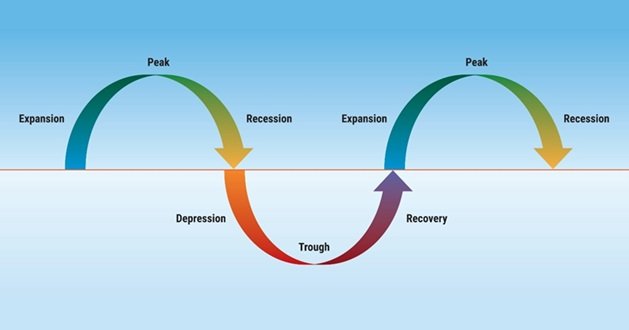
A traditional business cycle is commonly explained through four phases: boom, recession, depression, and recovery. These phases describe different levels of economic activity.
Boom Phase
The boom phase, also known as the peak or prosperity phase, represents a period of strong economic activity. During this phase, businesses experience higher demand, production increases, and employment opportunities generally expand.
Consumers may have greater confidence in the economy and spend more on goods and services. Businesses may invest in new machinery, technology, infrastructure, and expansion projects.
Key Characteristics of the Boom Phase:
- High consumer demand and spending.
- Increased industrial and business production.
- Rising employment and income levels.
- Higher business profits and investment.
- Strong market confidence.
- Possible inflationary pressure due to excessive demand.
For example, when demand for housing increases significantly, construction companies may start new projects, hire additional workers, and purchase more building materials.
However, a prolonged boom may create economic imbalances. Excessive borrowing, speculative investments, and rising prices can make the economy vulnerable to a downturn.
Recession Phase
A recession is a period of significant decline in economic activity that lasts for an extended period. It generally involves falling production, reduced business investment, weaker consumer spending, and increasing unemployment.
During a recession, consumers may reduce discretionary spending because of financial uncertainty. Businesses may experience declining sales and lower profits, forcing them to cut costs or delay expansion.
Key Characteristics of the Recession Phase:
- Declining consumer demand.
- Reduced business production and investment.
- Lower corporate profits.
- Increasing unemployment or reduced working hours.
- Greater financial uncertainty.
- Possible decline in household income.
For example, if consumers reduce spending on cars, electronics, and other expensive products, manufacturers may decrease production and postpone hiring.
A recession can affect different industries in different ways. Businesses selling essential goods may experience relatively stable demand, while travel, entertainment, luxury retail, and construction may face greater pressure.
It is also important to understand that two consecutive quarters of declining real GDP are often used as a simple rule of thumb for identifying a recession, but they are not a universal or sufficient definition.
Depression Phase
A depression is an unusually severe and prolonged economic downturn. It is generally more damaging than an ordinary recession and can involve substantial declines in production, investment, employment, and household income.
Businesses may shut down, financial institutions may experience serious difficulties, and unemployment may remain high for an extended period.
Key Characteristics of the Depression Phase:
- Severe and prolonged economic contraction.
- Very high unemployment.
- Major decline in business investment.
- Widespread business closures.
- Reduced consumer purchasing power.
- Serious financial and banking difficulties.
A famous historical example is the Great Depression of the 1930s. It began in the United States and spread across many parts of the world, causing widespread unemployment, business failures, and financial instability.
Depressions are relatively rare compared with ordinary recessions. Governments and central banks may introduce measures such as fiscal support, monetary easing, financial assistance, and employment programmes to help stabilise the economy.
Recovery Phase
The recovery phase begins when economic activity starts improving after a downturn. Consumer confidence gradually increases, businesses begin investing again, and production and employment may rise.
During recovery, companies may reopen facilities, recruit employees, introduce new products, and expand their operations. Consumers may become more willing to spend as financial conditions improve.
Key Characteristics of the Recovery Phase:
- Increasing production and business activity.
- Gradual improvement in employment.
- Rising consumer confidence.
- Growth in business investment.
- Improving household income and spending.
- Strengthening demand for goods and services.
For example, after a period of weak demand, a manufacturing company may receive more orders and gradually increase its production capacity.
Recovery does not always happen at the same speed across industries or regions. Some sectors may improve quickly, while others may take longer to return to their previous performance levels.
Difference Between Boom, Recession, Depression, and Recovery
| Phase | Economic Activity | Employment | Business Investment |
| Boom | High and expanding | Generally rising | Strong |
| Recession | Declining | Generally weakening | Falling |
| Depression | Severely depressed | Very low | Extremely weak |
| Recovery | Gradually improving | Increasing | Gradually rising |
Causes of Business Cycles
Business cycles can occur due to several economic and financial factors.
Changes in Consumer Demand: When consumers increase or reduce spending, businesses adjust production and investment.
Interest Rate Changes: Higher borrowing costs can reduce business investment and consumer spending, while lower rates may encourage economic activity.
Government Policies: Changes in taxation, public spending, subsidies, and regulations can influence economic growth.
Technological Developments: New technologies can create investment opportunities, increase productivity, and change existing industries.
Global Economic Events: Wars, international trade disruptions, pandemics, and financial crises can affect production and demand across countries.
Business Confidence: When companies expect stronger economic conditions, they may increase investment. Uncertainty can lead to delayed projects and reduced spending.
Importance of Understanding the Business Cycle
Understanding business cycles helps different economic participants make informed decisions.
- Businesses: Can adjust production, manage expenses, and plan investments according to economic conditions.
- Investors: Can evaluate market risks and make more informed investment decisions.
- Governments: Can use fiscal policies and public programmes to support economic stability.
- Consumers: Can plan savings, borrowing, and major purchases more carefully.
- Employees: Can understand changing employment conditions and prepare for possible job-market challenges.
Conclusion
A business cycle describes the fluctuations in economic activity over time. Its four traditional phases are boom, recession, depression, and recovery. A boom represents strong economic growth, while a recession involves declining economic activity. A depression is a much more severe and prolonged downturn, whereas recovery describes the gradual improvement that follows an economic decline.
These phases influence production, employment, consumer spending, investment, and business profitability. Understanding the business cycle helps companies, governments, investors, and individuals prepare for economic changes and make better financial decisions.
Frequently Asked Questions (FAQs)
Q. What is a business cycle in simple words?
A business cycle is the repeated rise and fall of economic activity over time, including periods of growth, decline, and recovery.
Q. What are the four phases of a business cycle?
The four traditional phases are boom, recession, depression, and recovery.
Q. What is the difference between recession and depression?
A recession is a significant decline in economic activity, while a depression is a much more severe and prolonged economic downturn involving deeper losses in production and employment.
Q. What happens during the boom phase?
During a boom, consumer demand, business production, investment, and employment generally increase. Economic confidence is usually strong.
Q. What happens during the recovery phase?
During recovery, production, consumer spending, employment, and business investment gradually improve after an economic downturn.
Q. How do business cycles affect businesses?
Business cycles influence sales, production, profits, employment, borrowing, and investment decisions. Businesses may expand during growth periods and reduce costs during downturns.